Most A/C compressors lubricate themselves with the freon that flows through the A/C system. In order to use these compressors for pumping air, you need to have an external oiler feeding air into the intake hose and a filter to remove the oil from the output hose. Certain York-style compressors (the big, boxy, vertical kind) used an internal oil reservoir for lubrication, which makes them ideal for use as stand-alone air compressors. These compressors were commonly used on AMCs, Fords, Volvos, Porsches, International Harvesters, and Oldsmobiles in the ’70’s and early ’80’s.
Therold Enterprises used to make mounting brackets and alternator pulleys to mount an AMC York onto a current Jeep 4- or 6-cyl engine. Therold closed up shop in the late-1990’s, and Brad Kilby eventually bought all his stuff and started selling all the necessary parts for an on-board air setup at www.OnBoardAir.com.
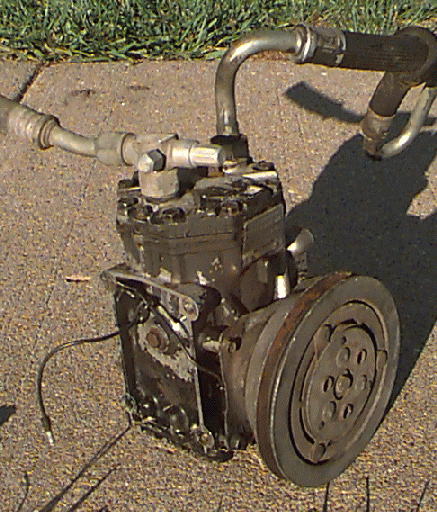
York compressor fittings
Unless you have gobs of vertical hood clearance, you really want to get the AMC-style hose connectors, which run horizontally across the top of the compressor. The Ford-style connectors stick vertically out of the top of the compressors and then bend over to connect with the A/C hoses, which adds about 3″ to the total height of the unit. The good news is that these connectors are just screwed into the top of the compressor, and the two connector styles are interchangeable on the same compressor. The bad news is that the screw threads on the connectors are closer together than those on most 3/4″ pipe fittings, so it’s nearly impossible to find connectors anywhere but on another York compressor. At left is a photo of my Ford-style compressor. The photo shows one Ford-style hose connector and one AMC-style connector so you can see the difference.
Another difference between the AMC and Ford versions is the pulley. The AMC pulley is positioned very close (1/2″) to the body of the compressor. The Ford pulley sticks out about two inches away from the body. This might make a difference in your mounting bracket because the belt obviously needs to line up evenly with the pulley on the other end.
The third difference is in the cylinder displacement. There are three different cylinder displacements, ranging from barely 6 cubic inches to over 10 cubic inches. The larger the displacement, the more air the compressor can pump per minute. This doesn’t vary by auto maker, so there are two ways to tell which displacement you’ve got:
- If your compressor still has a metal York (not Motorcraft) ID
tag bolted to the front of it, there will be a number on the
tag that looks like “F2XXY“, where:XX Cylinder Displacement 10 = 10.3 ci (169 cc)
09 = 8.69 ci (142 cc)
06 = 6.10 ci (100 cc)
Y Discharge Direction
L = left
R = right
- Take off the clutch and look at the crankshaft.
- Remove the center bolt (1/2″ socket).
- Remove the large washer.
- Run a 2″ long, 5/8″ coarse thread bolt in until it bottoms against the crankshaft and forces the clutch off.
- Look at the end of the crankshaft. The end is flat on all models.
- If the edge of the flat end is beveled, you’ve got the small displacement.
- If it’s a sharp corner, but with a thin groove for a retaining clip, you’ve got the medium displacement.
- If it’s a sharp corner without any groove, you’ve got the large displacement.
Climate Control, Inc, makers of the York compressor, have made the service manual available online. It contains lots of good information.